
To the modern traveler, a train terminal is often seen as just a kinetic filter. It is a place of frantic transitions, digital alerts, and the rhythmic hum of departure. We navigate these spaces with a utilitarian focus. Our eyes are fixed on the schedule. We overlook the structural skin that contains us. Yet, the DC train terminal is not a mere transit point; it is an exercise in civic resonance. Architectural historians of a previous era designed it as a masterwork. Their intention was to arrest the traveler’s momentum. They aimed to replace it with a sense of monumental stillness.
By looking beyond the commute, we uncover a sophisticated neoclassical vernacular. This vernacular intends to elevate the human experience from the mundane to the magnificent.
The Basilica of Motion
Upon entering the terminal, one is immediately struck by a spatial hierarchy. This hierarchy mirrors the great public works of imperial Rome. The interior features massive barrel vaults. There is a rhythmic layering of “nested” arches—archivolts. These frames create subsequent openings to offer an incredible depth of field. This architectural choice intentionally references the ancient Roman basilica. Such a space was traditionally reserved for high-stakes civic and legal discourse.

The result is a “hushed” atmosphere where the sheer volume of the hall swallows the cacophony of the crowd. The massive scale of the masonry impresses travelers. The height of these towering arches enhances this impression. They are designed to make the act of travel feel like a significant civic event. By moving through such a monumental space, the passenger is more than just a commuter. They become a participant in a grand, shared journey. They are dignified by the very walls that surround them.
Philosophy Crowning the Gate
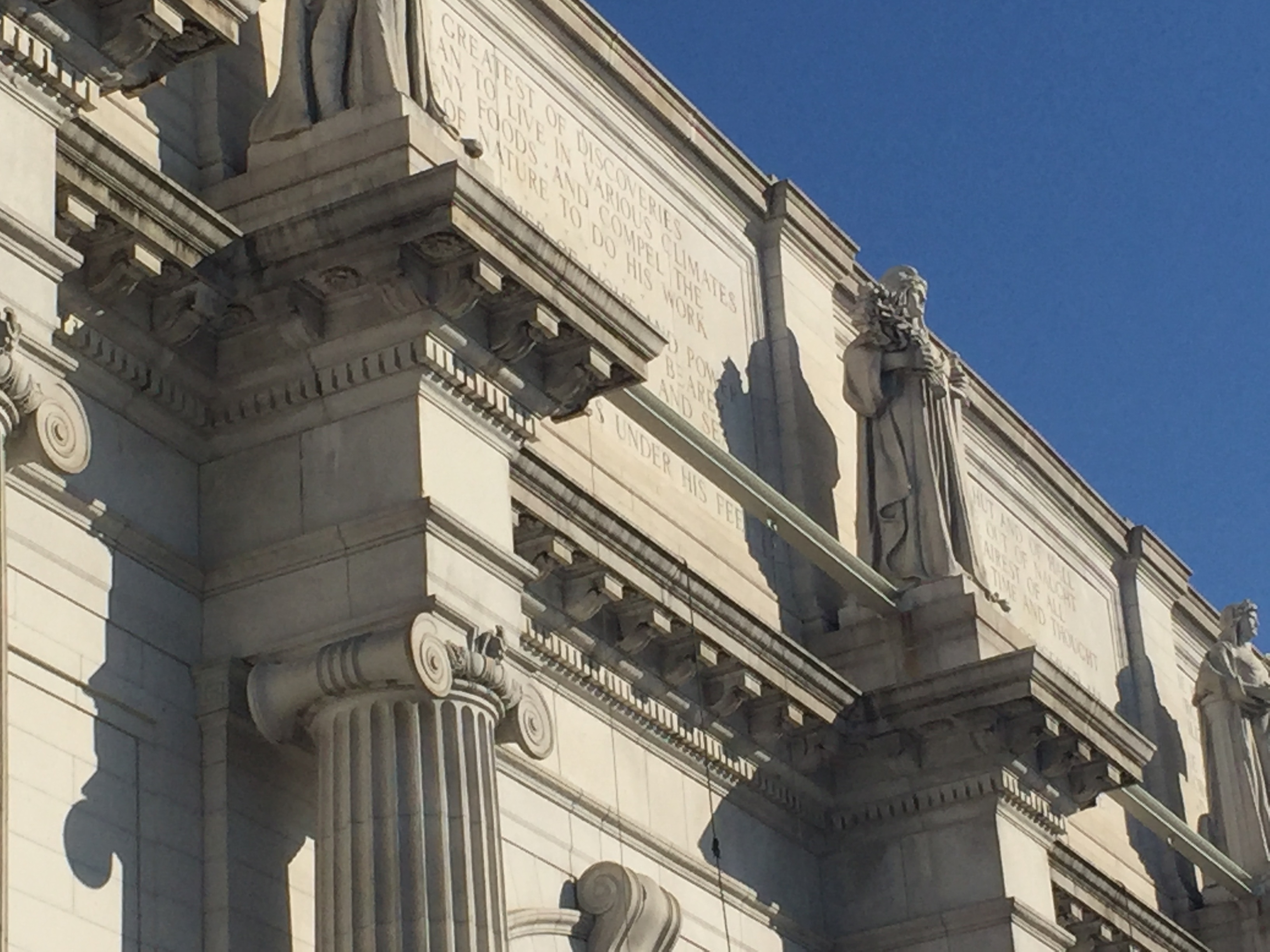
Contemporary transit hubs focus on advertising and logistical signage. However, this terminal uses its exterior attic story as a canvas for philosophical reflection. The attic story is the section of the wall above the main cornice. These inscriptions crown the entrance. Flanked by allegorical figures, they are etched into the ashlar blocks. They remind us of the weight of human progress.
The building’s facade features the following text:
“GREATEST OF DISCOVERIES… TO LIVE IN VARIOUS CLIMATES… NATURE TO DO HIS WORK”
Placing musings on the conquest of geography and the laws of nature at a train station is a profound choice. To a cultural architect, this signifies the triumph of technology over the limitations of the natural world. The train was the first true tool that allowed humanity to “live in various climates” with ease. These words encourage the traveler to view the iron rail not just as a convenience. It represents the fulfillment of a long-standing human ambition to harmonize our work with the forces of nature.
The Guardians of Time and Virtue
As we cast our gaze upward, we encounter the silent sentinels of the hall. They are a series of stoic, robed figures. These figures provide a psychological sense of order. However, a closer look reveals a thoughtful distinction between the figures inside and those without. Inside the terminal, the statues are “Protectors.” Positioned along the ledges and guarding the central clock, they stand in stoic poses. They hold shields, suggesting a fortress of civilization. This fortress guards the traveler against the chaos of the outside world.

Conversely, the figures on the exterior facade serve as “Educators” or “Muses.” Holding scrolls and books, these statues represent the intellectual and philosophical virtues that built the nation. The transition from the “Protectors” of the interior to the “Educators” of the exterior initiates a narrative. This narrative speaks of safety and enlightenment. They reinforce the idea that the terminal is a sacred public trust—a stable, historical anchor in an ever-moving world.
The Golden Geometry of the Heavens
The architectural journey reaches its peak with a vertical gaze toward the ceiling. Here, the chaos of the terminal floor is met with a sense of infinite mathematical order. The massive vaults are adorned with hexagonal coffers, each intricately recessed and highlighted with delicate gold-leaf accents. This repetition of geometric patterns creates a visual rhythm. It suggests an “infinite” space. It provides a stabilizing anchor for the mind.

What makes this secret truly compelling is the juxtaposition of this ancient design with the realities of modern adaptive use. Directly beneath the gold-leaf coffers and the classical arches, one finds the vibrant glow of contemporary digital arrival screens. The bold signage of “SHACK” (Shake Shack) kiosks is also present. There is a contrast between the eternal geometry of the heavens and the commercial pulse of the 21st century. This contrast is a hallmark of the station’s longevity. It proves that great architecture can remain relevant, housing the ephemera of modern life within a shell of timeless beauty.
A New Perspective on Your Next Trip
The architecture of our public infrastructure is never accidental. Every arch, inscription, and sentinel in the DC terminal was meticulously placed. They were designed to influence our mental state and frame our perspective on the journey ahead. The next time you find yourself awaiting a departure, challenge yourself to look up.
Takeaway to Ponder: We should treat our daily transitions with the same reverence as this architecture. This change in perspective might alter how we view “wasted time.” We might start seeing daily transitions as valuable and meaningful. We might start to appreciate these moments more.