Per Cap Payments are now known as Health/Welfare Payments?
This post covers the Per Cap Ordinance or Title 7, Chapter 2.
To the casual observer, it looks like a simple dividend; to the Hannahville Indian Community, it is an exercise in fiscal sovereignty and fiduciary duty.
The “fine print” of the Community’s 2019 Per Capita Ordinance reveals a rigorous legal framework designed to balance individual liquidity with the long-term survival of the tribe. Moving beyond the surface-level fascination with “free money,” we find a document that prioritizes institutional stability over individual windfalls. Here are the realities of how this wealth is actually managed behind the scenes.
The 49.9% Ceiling
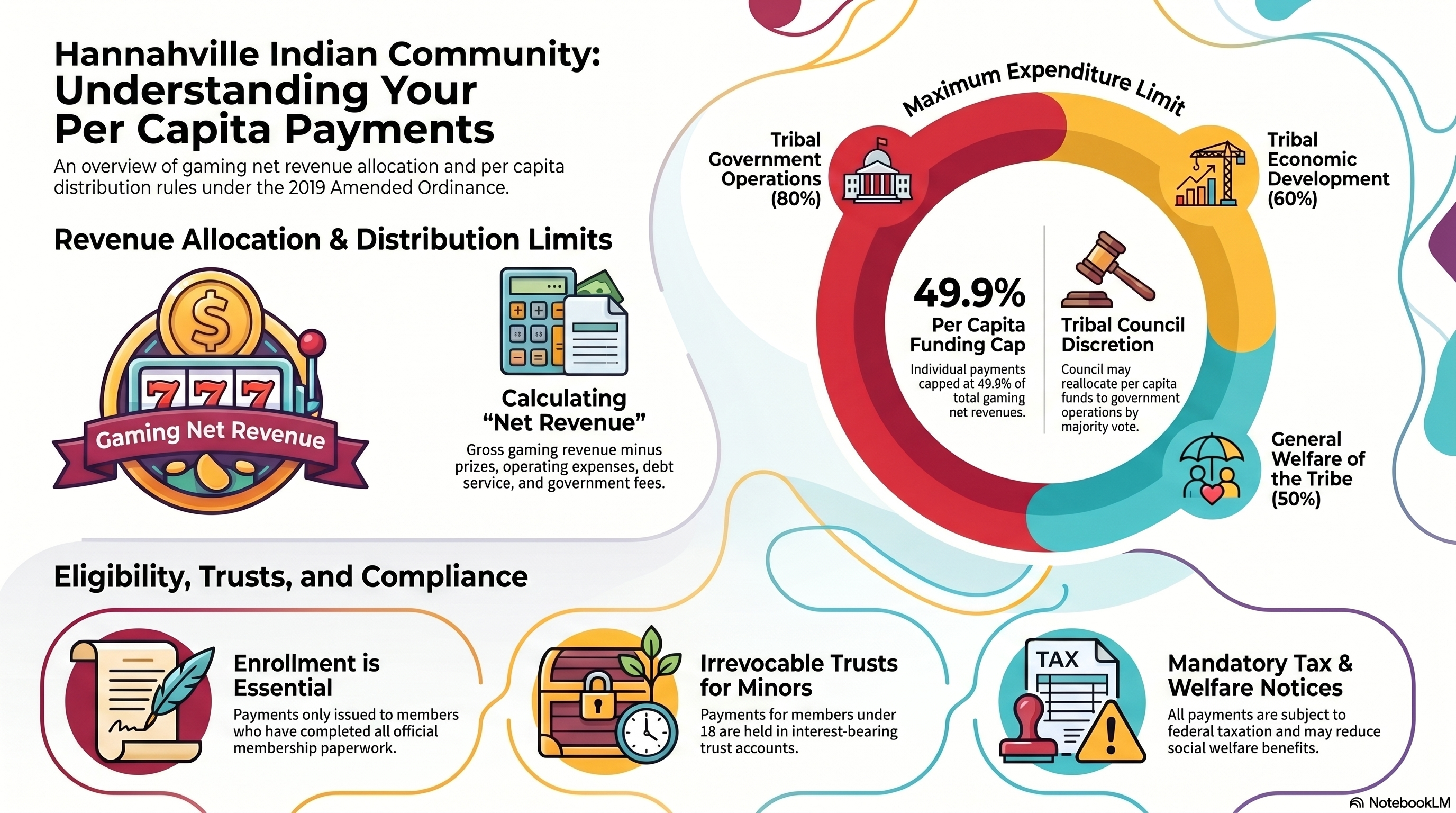
A pervasive myth in the gaming industry is that net profits flow directly into the pockets of tribal members. In reality, the Hannahville Ordinance establishes a strict 49.9% cap on per capita distributions. This isn’t just a random figure; it is a calculated safeguard for the tribe’s government operations.
To understand the math, one must first define “Net Revenues.” Per Section 7.2.300, this is gross gaming revenue minus prizes, operating expenses, and payments to state/local governments. Crucially, this calculation excludes management fees paid to third-party operators or management contracts. Once “Net Revenue” is determined, the Tribal Council must navigate a series of competing interests for those funds:
- Up to 80% for tribal government operations and programs.
- Up to 60% for tribal economic development.
- Up to 50% for the general welfare of the Tribe and its members.
- Up to 10% for local government agencies.
- Up to 5% for charitable organizations.
Because Section 7.2.300(c) mandates that total expenditures must not exceed 100%, these categories are slices of a pie. By capping individual payments at less than half of the profit while allowing up to 80% for government operations, the Community ensures that the institution remains solvent even if individual distributions must be curtailed.
The “Tribe-First” Debt Priority
While per capita payments are often viewed as an entitlement of membership, they are not immune to the tribe’s power as a creditor. Under Section 7.2.700, the Community administration retains the right to withhold payments to satisfy any payroll advances or debt owed to the Tribe, including defaulted loans.
The most striking aspect of this “Tribe-First” hierarchy is how it handles child support. In many jurisdictions, child support is a “super-priority” debt; however, in the realm of tribal sovereignty, the collective health of the Community takes precedence. Section 7.2.700(c) explicitly states:
“If the Tribal member has debts owed to the Hannahville Indian Community and for child support, then the debts owed to the Hannahville Indian Community are to be given priority over any child support obligations.”
This ranking ensures that the Community’s treasury is made whole before the individual’s external legal obligations are addressed via the per capita pool.
Wealth Protection and Intergenerational Equity
The ordinance treats wealth distribution for minors and “legally incompetent persons” with a heightened level of fiduciary care. Under Section 7.2.400, funds for members under 18 are held in an “Irrevocable Trust for Children Enrolled in the Hannahville Indian Community.”
The Tribal Council acts as a “prudent investor,” pooling these assets to maximize returns and ensuring that the money serves as a long-term safety net rather than a liquid asset for parents to tap into. For legally incompetent persons, the oversight is even more granular. If a legal guardian is delegated to use the funds for the member’s health, welfare, or education, they are subject to a monthly reporting requirement (Section 7.2.400(b)(3)). This level of administrative rigor prevents the erosion of individual wealth and reinforces the tribe’s commitment to intergenerational equity.
The Hidden Cost of “Free” Money
Receiving a per capita or Health/Welfare check is not without its traps. Section 7.2.500 mandates that every payment be accompanied by a warning regarding federal and state taxation. To maintain rigorous compliance, the Tribe explicitly references Sections 63(c) and 151(d) of the Internal Revenue Code; if a payment exceeds the basic standard deduction and exemption amounts defined therein, the Tribe is legally required to withhold taxes.
Furthermore, there is the “Social Welfare Trap.” The ordinance explicitly warns that these payments can legally trigger a reduction in other social welfare benefits. For a recipient on the edge of eligibility for state or federal assistance, a per capita check could ironically result in a net loss of total support, turning a benefit into a bureaucratic liability.
Geography Doesn’t Dictate Eligibility
One of the elements of the ordinance is found in Section 7.2.800, which confirms that residency is not a requirement for payment. An enrolled member does not need to live on the reservation to receive their equal share.
This policy acknowledges the reality of the tribal diaspora. It allows members to pursue higher education or professional careers globally while maintaining a “financial umbilical cord” to their community. By decoupleing residency from revenue sharing, the Community ensures that its economic success supports the entire tribal body, regardless of geographic borders.
No Such Thing as “Back-Pay”
The ordinance is designed to protect the current fund from being diluted by new claimants. Section 7.2.1000 is clear: new members have no right to retroactive payments. Enrollment grants a right to future distributions only, starting on the first scheduled date after the paperwork is finalized.
Perhaps more significantly, the “no back-pay” rule applies even if the Tribe itself suspends payments. According to Section 7.2.300(d)(2)(B), if the Tribal Council reallocates funds to government operations, it does not create a debt to the members. Any “missed” payments during a reallocation period are gone forever—they do not accumulate as arrears. To protect this system, the ordinance carries significant “teeth”: anyone wrongfully receiving or distributing funds faces a civil fine of $1,500 or three times the amount in question, alongside the possibility of criminal prosecution and simultaneous administrative remedies.
The Final Thought: A Balancing Act
The Hannahville Indian Community’s 2019 Per Capita Ordinance is far more than a simple payout schedule; it is a document of profound economic strategy. It balances the individual’s right to “equal shares” with the collective’s need for infrastructure, debt recovery, and institutional longevity.
Crucially, Section 7.2.1600 reminds all parties that this entire system exists under the umbrella of Sovereign Immunity. The Tribe provides these benefits as a sovereign entity, and the ordinance does not constitute a waiver of that immunity. It leaves us with a provocative question: Is this model of “calculated generosity”—where the institution is fortified before the individual is paid—the ultimate blueprint for sustainable tribal wealth, or is it a legal maze that ensures the House always wins?