How Modern Playgrounds Are Quietly Reshaping Childhood Fitness
For many of us, the word “playground” evokes a distinct sensory memory. We can hear the rhythmic clanking of rusted chains. We smell the scent of sun-scorched metal slides. We feel the jarring impact of a basic wooden swing.
These traditional structures were the staples of 20th-century neighborhoods—functional, if unimaginative, arenas for burning off excess energy. However, our society is grappling with an increasingly sedentary, screen-mediated lifestyle.
As a result, the architecture of our public parks is undergoing a sophisticated transformation. A shift toward a new era of “Active Urbanism” is occurring. Play equipment is no longer just a toy. It is a piece of sculptural utility designed to engage both the physique and the intellect.
The Kinetic Globe: Reimagining the Spin
An example of this evolution is the emergence of focused, kinetic structures. One such structure is the vibrant yellow spherical spinner. This differs from the traditional merry-go-round. The merry-go-round often relied on passive centrifugal force and a chaotic group dynamic. This modern structure is designed for a singular, concentrated experience.

In this design, a child sits perched on a red seat within the protective, arcing yellow ribs of a sphere. One notices a strong focus when looking at the user closely.
The frantic laughter of the past is gone. Instead, there is a look of intense, quiet determination. This is the visual evidence of a “flow state.” The equipment demands a specific type of vestibular development. It requires the child to navigate gravity and momentum through core engagement and grip. It is an individual mastery of physics, turning a simple spin into a meditative exercise in balance.
“Modern play architecture has moved past the era of ‘burning energy.’ It has entered the era of ‘building intent.’ In this era, every spin and stride requires cognitive presence.”
The Rise of the “Play-Gym”: Fitness for All Ages
The most significant trend in modern park planning is “Intergenerational Design.” It intentionally blurs the lines between a child’s play area and an adult’s fitness zone.
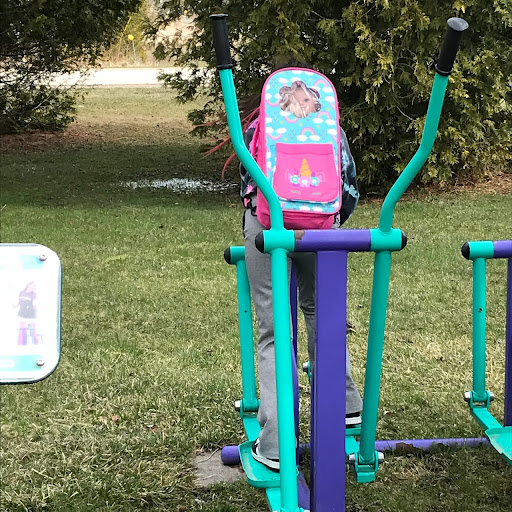
This “gym-ification” of public space is perfectly captured by the sight of a child. The child is mastering a teal and purple elliptical machine.

This isn’t just “play” in the traditional sense; it is a guided physical environment. Note the instructional signage positioned adjacent to the machine, featuring diagrams that serve as a user manual for the public. There is a fascinating juxtaposition of scale here. The small hands of the child reach up to the towering teal handles. These handles are clearly designed for adult proportions. By placing these professional-grade ergonomic interfaces in a park setting, urban designers are normalizing fitness. They are changing the park. It is no longer merely a place where parents sit on the sidelines. It is becoming a multi-generational wellness hub where a “workout” and “play” are functionally identical.
The Aesthetic of Motion: Color, Form, and Function
The visual language of these modern installations is a deliberate departure from the primary-colored plastics of the previous decade. Today’s parks utilize “Tactile Architecture” to invite participation. They achieve this through intuitive design. The shape of the object dictates the movement of the body.
Conclusion: What’s Next for Public Spaces?
Our cities are changing as we look toward the future. The humble playground is being replaced by sophisticated outdoor wellness centers. These spaces are no longer an afterthought in urban planning. They represent the front lines of a movement to reintegrate movement into the fabric of daily life.
Have you noticed your local park transforming? The next time you walk past a public green space, pause for a moment. Look closer at the “geometry of play.” You might find that the equipment is doing much more than providing a place to climb. It is quietly reshaping how an entire generation views the relationship between their bodies and the environment around them.