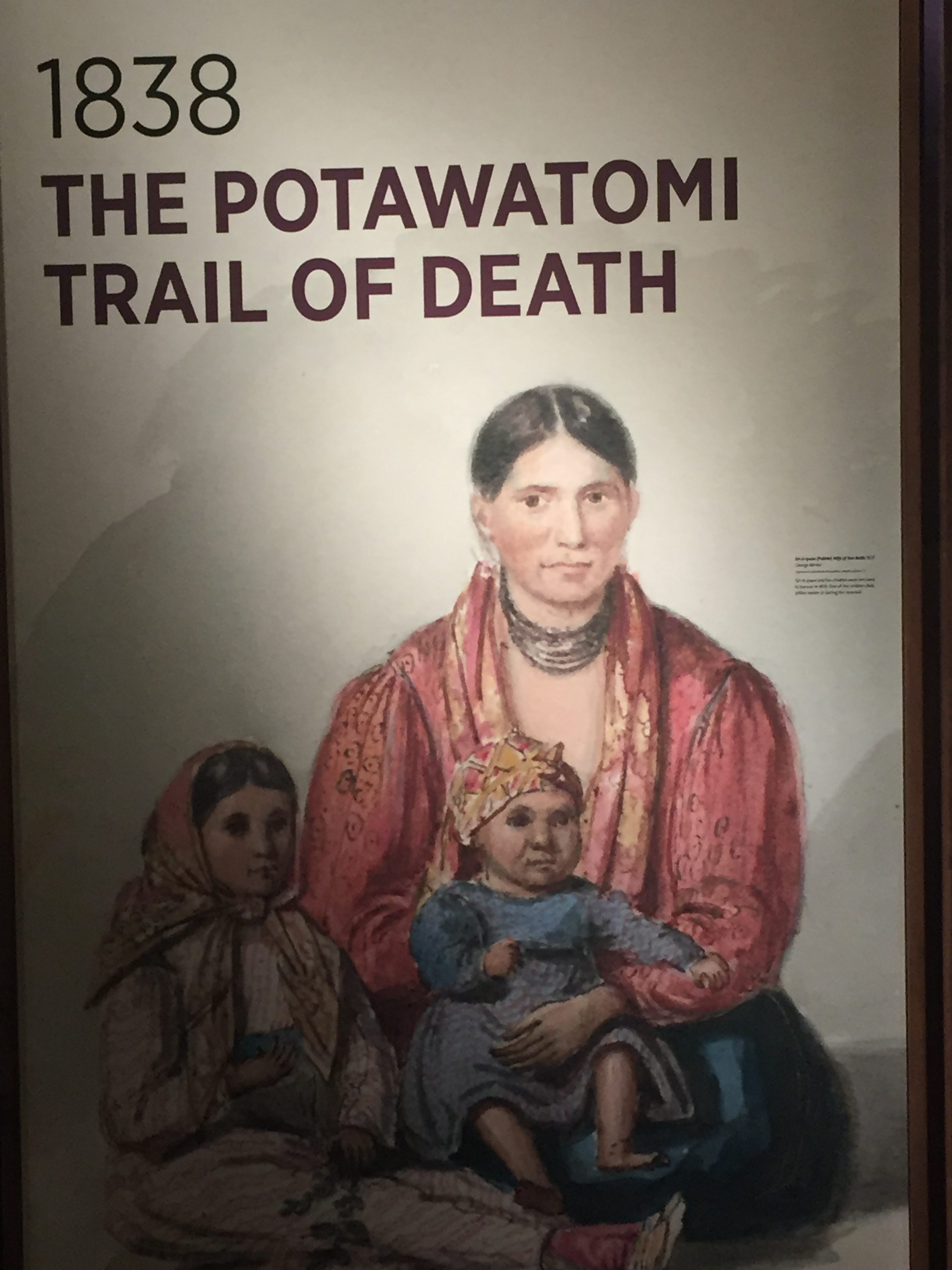
The Weight of a 660-Mile March
In the popular imagination, 19th-century treaties are often depicted as dignified ceremonies—formal gatherings where sovereign leaders exchanged parchment and promises. But as one walks through the corridors of history, the artifacts tell a darker, more visceral story. The reality for the Potawatomi Nation was not marked by diplomatic grace. Instead, it was a systemic “ruthless grab” for land and money.
In 1838, the facade of diplomacy crumbled entirely. It was replaced by the forced 660-mile march from Twin Lakes, Indiana, to the Kansas Territory. This journey, forever remembered as the “Trail of Death,” was the tragic conclusion to decades of deception. It is a story best understood by contrasting the cold, bureaucratic language of the U.S. government. Leaders like Chief Menominee spoke in defiance. He refused to be driven from “the graves of my tribe and my children.”
The Illusion of Choice: 28 Treaties in 25 Years
The dispossession of the Potawatomi was not a singular event, but a relentless erosion. Between 1816 and 1841, the United States government approached the Potawatomi with 28 separate treaties. By 1821, these constant demands for land sales were “cutting away the heart of the Potawatomi homeland.”
The “appearance of choice” offered in these negotiations was a calculated tactic. As 1.5 million newcomers flooded into the upper Midwest, they brought ecological changes that devastated the Potawatomi’s diverse woodland economy. Traditional hunting and gathering grounds were vanishing. The Potawatomi could only pay mounting debts to unscrupulous traders by selling their very soil.
U.S. commissioners secured these “deals” through a toolkit of coercion:
- Tactical Debauchery: Whiskey flowed freely during negotiations to compromise indigenous leadership.
- Bribes and Favoritism: Influential chiefs and interpreters were often paid off to side with U.S. interests.
- Fabricated Uprisings: Trivial clashes between Potawatomi and settlers were frequently exaggerated into “Indian uprisings.” This exaggeration gave government agents the pretext to threaten punishment. They would also demand land as “compensation.”
The Radical Resistance of Chief Menominee
Among the voices of resistance, none was more steadfast than that of Chief Menominee. He stood in direct opposition to the 1836 Treaty with the Potawatomi, a document that perfectly encapsulates the “ruthless grab.” In this treaty, the United States agreed to pay “fourteen thousand and eighty dollars in specie.” This payment was in exchange for “twenty-two sections of land.” It was a pittance for vast tracts of ancestral territory. The treaty also demanded the Potawatomi remove themselves west of the Mississippi within two years.
While the official treaty pages in the National Archives represent the government’s “legal” victory, Menominee’s 1838 response reveals the human soul behind the resistance:
“The President does not know the truth. . . . He does not know that I have refused to sell my lands, and still refuse. He would not, by force, drive me from my home. My home includes the graves of my tribe and my children who have gone to the Great Spirit. . . . I have not sold my lands. I will not sell them. I have not signed any treaty, and I shall not sign any.”
Menominee’s words highlight the chasm between the lived truth of indigenous sovereignty and the sterile paperwork used to erase it. Ultimately, his resistance was met with the bayonets of the militia.
The Haunting Repetition of the “Journal of an Emigrating Party”
The physical toll of the 1838 removal is preserved in the “Journal of an Emigrating Party.” This journal is a daily log of the march. These entries do not speak of grand politics; they speak of dust, thirst, and the biting frost.
The journal describes a landscape of misery. There was extreme heat that rendered “marches more distressing.” Water was found only in “stagnant ponds.” By late October, the weather turned “exceedingly cold.” The entry for October 24th offers a sad glimpse into the conditions. “A quantity of Shoes were distributed among the… barefooted Indians, the weather being too severe for marching without a covering to the feet.”
However, the most visceral impact of the journal lies in its repetitive, clinical reporting of mortality. The records are punctuated by variations of a single, devastating phrase:
- September 9: “A CHILD DIED” during the day and another “A CHILD DIED since dark.”
- September 17: “A YOUNG CHILD DIED directly after coming into camp.”
- September 23: “A CHILD DIED early this morning. ONE ALSO DIED on the way.”
- September 25: “A CHILD ALSO DIED this evening.”
- October 4: “A YOUNG CHILD DIED in the Evening.”
These brief, staccato entries strip away the abstraction of history. They force the reader to confront the vulnerability of the youngest participants in this forced exile.
Lost Knowledge: The Tragedy of the Prescription Stick
Displacement is more than a loss of land; it is a literal “uprooting” of scientific and cultural expertise. This is most poignantly seen in the Potawatomi prescription stick (ca. 1890). These wooden artifacts, covered in intricate etched symbols, served as the botanical and medical encyclopedias of Potawatomi doctors.
The Potawatomi were forced onto the eastern Plains of Kansas. As a result, the knowledge recorded on these sticks became tragically obsolete. The specific medicinal plants had sustained the health of the people for generations. These plants did not grow in the new environment. The new setting was simply too arid for them. This loss is a permanent severance of a people’s scientific link to the natural world. It is a theft of the intellect as much as the earth.
Spiritual Landscapes on a Panel Bag
In the wake of losing their physical medicines, the Potawatomi leaned more heavily on their spiritual medicine. This resilience is woven into the very fabric of Potawatomi panel bags from the mid-19th century. These bags were crafted from materials like bast fiber yarns. Examples include nettle and wool. They served a greater purpose than mere containment. They mapped out a sacred cosmology.
The bags featured “cosmological creatures”. These creatures included the Thunderbird, the spiritual being of the sky. They also included the Underwater Panther, the spiritual being of the underworld. To the Potawatomi, human well-being was inextricably tied to a sacred landscape inhabited by these beings. After arriving in Kansas, the Potawatomi continued to weave these creatures into their art. This practice helped them reconstruct their connection to the universe. They carried their landscape with them in their hands, even as the ground beneath their feet was stolen.
Beyond the Road
The Potawatomi Trail of Death was paved with broken promises and fueled by the hunger for “progress.” There is a profound, bitter irony in the geography of this removal. Maps from 1833 show the “Michigan Road” and the “Wabash-Erie Canal.” These infrastructure projects were designed to link the Ohio River to Lake Michigan and Lake Erie. These were the celebrated symbols of a developing nation, built to bring “newcomers” and commerce in.
In 1838, these roads and canals served critical roles. They were the exit ramps for the Potawatomi. These routes were the conduits used to march them into exile. The physical landscapes we inhabit today, and the modern thoroughfares we drive upon, often hold these hidden echoes.
We must ask ourselves a critical question. How many of our daily routes were built upon the “ruthless grabs” for land? Leaders like Menominee died resisting these grabs. We must acknowledge the “truth” that Menominee claimed the President did not know. This is the first step in understanding the true cost of the land we call home.
Deception and Resilience on the Potawatomi Trail of Death
The Weight of a 660-Mile March
In the popular imagination, 19th-century treaties are often depicted as dignified ceremonies—formal gatherings where sovereign leaders exchanged parchment and promises. But as one walks through the corridors of history, the artifacts tell a darker, more visceral story. The reality for the Potawatomi Nation was stark. It was not characterized by diplomatic grace. Instead, it was marked by a systemic “ruthless grab” for land and money.
In 1838, the facade of diplomacy crumbled entirely. It was replaced by the forced 660-mile march from Twin Lakes, Indiana, to the Kansas Territory. This journey, forever remembered as the “Trail of Death,” was the tragic conclusion to decades of deception. It is a story best understood by contrasting the cold, bureaucratic language of the U.S. government. Leaders like Chief Menominee offered a defiant voice. He refused to be driven from “the graves of my tribe and my children.”
The Illusion of Choice: 28 Treaties in 25 Years
The dispossession of the Potawatomi was not a singular event, but a relentless erosion. Between 1816 and 1841, the United States government approached the Potawatomi with 28 separate treaties. By 1821, these constant demands for land sales were “cutting away the heart of the Potawatomi homeland.”
The “appearance of choice” offered in these negotiations was a calculated tactic. As 1.5 million newcomers flooded into the upper Midwest, they brought ecological changes that devastated the Potawatomi’s diverse woodland economy. Traditional hunting and gathering grounds were vanishing. The Potawatomi had to sell their very soil to pay mounting debts to unscrupulous traders.
U.S. commissioners secured these “deals” through a toolkit of coercion:
- Tactical Debauchery: Whiskey flowed freely during negotiations to compromise indigenous leadership.
- Bribes and Favoritism: Influential chiefs and interpreters were often paid off to side with U.S. interests.
- Fabricated Uprisings: There were trivial clashes between Potawatomi and settlers. These small conflicts were often exaggerated into “Indian uprisings.” This exaggeration gave government agents the pretext to threaten punishment and demand land as “compensation.”
The Radical Resistance of Chief Menominee
Among the voices of resistance, none was more steadfast than that of Chief Menominee. He stood in direct opposition to the 1836 Treaty with the Potawatomi, a document that perfectly encapsulates the “ruthless grab.” In this treaty, the United States agreed to pay “fourteen thousand and eighty dollars in specie.” This payment was in exchange for “twenty-two sections of land”—a pittance for vast tracts of ancestral territory. The treaty also demanded the Potawatomi remove themselves west of the Mississippi within two years.
While the official treaty pages in the National Archives represent the government’s “legal” victory, Menominee’s 1838 response reveals the human soul behind the resistance:
“The President does not know the truth. . . . He does not know that I have refused to sell my lands, and still refuse. He would not drive me from my home by force. This includes the graves of my tribe and my children who have gone to the Great Spirit. . . . I have not sold my lands. I will not sell them. I have not signed any treaty, and I shall not sign any.”
Menominee’s words highlight the chasm between the lived truth of indigenous sovereignty and the sterile paperwork used to erase it. Ultimately, his resistance was met with the bayonets of the militia.
The Haunting Repetition of the “Journal of an Emigrating Party”
The physical toll of the 1838 removal is preserved in the “Journal of an Emigrating Party.” It is a daily log of the march. These entries do not speak of grand politics; they speak of dust, thirst, and the biting frost.
The journal describes a landscape of misery. There was extreme heat that rendered “marches more distressing.” Water was found only in “stagnant ponds.” By late October, the weather turned “exceedingly cold.” The entry for October 24th is heartbreaking. It provides an image of the conditions: “A quantity of Shoes were distributed among the… barefooted Indians, the weather being too severe for marching without a covering to the feet.”
However, the most visceral impact of the journal lies in its repetitive, clinical reporting of mortality. The records are punctuated by variations of a single, devastating phrase:
- September 9: “A CHILD DIED” during the day and another “A CHILD DIED since dark.”
- September 17: “A YOUNG CHILD DIED directly after coming into camp.”
- September 23: “A CHILD DIED early this morning. ONE ALSO DIED on the way.”
- September 25: “A CHILD ALSO DIED this evening.”
- October 4: “A YOUNG CHILD DIED in the Evening.”
These brief, staccato entries strip away the abstraction of history. They force the reader to confront the vulnerability of the youngest participants in this forced exile.
Lost Knowledge: The Tragedy of the Prescription Stick
Displacement is more than a loss of land; it is a literal “uprooting” of scientific and cultural expertise. This is most poignantly seen in the Potawatomi prescription stick (ca. 1890). These wooden artifacts, covered in intricate etched symbols, served as the botanical and medical encyclopedias of Potawatomi doctors.
The Potawatomi were forced onto the eastern Plains of Kansas. As a result, the knowledge recorded on these sticks was rendered tragically obsolete. The specific medicinal plants that had sustained the health of the people for generations were absent. They simply did not grow in the new, arid environment. This loss is a permanent severance of a people’s scientific connection to the natural world. It is a theft of the intellect as much as the earth.
Spiritual Landscapes on a Panel Bag
In the wake of losing their physical medicines, the Potawatomi leaned more heavily on their spiritual medicine. This resilience is woven into the very fabric of Potawatomi panel bags from the mid-19th century. Crafted from materials like bast fiber yarns (such as nettle) and wool, these bags were more than containers. They were maps of a sacred cosmology.
The bags featured “cosmological creatures.” The Thunderbird is the spiritual being of the sky. The Underwater Panther is the spiritual being of the underworld. To the Potawatomi, human well-being was inextricably tied to a sacred landscape inhabited by these beings. The Potawatomi continued to weave these creatures into their art after their arrival in Kansas. Through this practice, they reconstructed their connection to the universe. They carried their landscape with them in their hands, even as the ground beneath their feet was stolen.
Beyond the Road
The Potawatomi Trail of Death was paved with broken promises and fueled by the hunger for “progress.” There is a profound, bitter irony in the geography of this removal. Maps from 1833 show the “Michigan Road.” They also show the “Wabash-Erie Canal.” These infrastructure projects were designed to link the Ohio River to Lake Michigan. They were also meant to connect to Lake Erie. These were the celebrated symbols of a developing nation, built to bring “newcomers” and commerce in.
In 1838, these very roads and canals served as the exit ramps for the Potawatomi. They were the conduits used to march them into exile. The physical landscapes we inhabit today, and the modern thoroughfares we drive upon, often hold these hidden echoes.
We must ask ourselves a critical question. How many of our daily routes were built upon the “ruthless grabs” for land? Leaders like Menominee died resisting these grabs. Recognizing the “truth” Menominee referred to is crucial. The President did not know this truth. Understanding this is the first step in comprehending the true cost of the land we call home.

Leave a Reply