
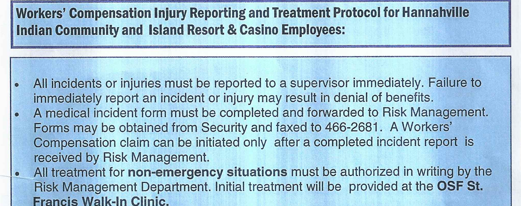

When an employee crosses the boundary onto tribal land, they aren’t just entering a different community. They are entering a distinct legal jurisdiction. Have you ever wondered what happens to your workplace protections? This question arises when your employer is a sovereign tribal government. This situation is different from working for a private corporation.
The Hannahville Indian Community (the “Community”) has taken a bold stand by “unplugging” from the Michigan state system. Instead of participating in the state’s insurance pool, the Tribe has established its own self-funded Workers’ Compensation Code. I work as a consultant specializing in tribal labor relations.
Here are the five most surprising takeaways from this sophisticated legal framework.
1. The $350,000 Line in the Sand (and Its Flexible Future)
One of the most distinct features of the Hannahville Code is the “Maximum Allowable Recovery Amount.” Under Section 5.2.103(2)(e), the Tribe draws a firm financial line regarding work loss benefits. The Tribe covers “reasonable and necessary” medical costs without a hard cap. However, the coverage for wage loss has a strict limit.
“maximum allowable recovery amount” – the maximum amount that a self-insured employer or insurer subject to this Code shall be liable to pay. This amount is exclusive of medical costs. It covers work loss benefits to an injured worker. The maximum allowable recovery amount for which a self-insured employer shall be responsible shall not be more than $350,000.00 per claim for work loss benefits unless there is an excess loss insurance policy in effect…
This hard cap protects the long-term financial stability of the tribal government. However, it isn’t set in stone. The Code allows the Tribal Council to adjust this amount by resolution. This adjustment accounts for economic shifts. This exercise of sovereign flexibility ensures the “shield” remains fair to both the fund and the worker.
2. The Sovereign Shield: Benefits as a “Grant,” Not a Waiver
To the uninitiated, Section 5.2.102(2) might seem like legal hair-splitting, but for the Tribe’s legal defense, it is everything. The Community presents its workers’ compensation program as a voluntary “grant” of benefits. It is not framed as a legal waiver of its sovereign immunity.
Why does this matter? In the state system, an insurance policy is a “right” that can be enforced in state courts. At Hannahville, if a worker attempts to sue the Tribe in a state forum, the “Shield” intervenes. It causes the case to be dismissed. This ensures that the worker receives protections “substantially similar” to Michigan law. Meanwhile, the Tribe’s trust property remains untouchable.
…nothing in this Code shall be construed to operate as an authorization for private suit against the Community. It shall not be seen as a waiver of the Community’s sovereignty… The Community does not consent to the levy of any judgment on its trust or property. This includes any lien or attachment…
3. Mental Health and Aging: The “Actual Events” Standard
The Hannahville Code sets a rigorous evidentiary bar for non-physical injuries, effectively protecting the fund from “ordinary diseases of life.” According to Section 5.2.113(2), there is a sharp distinction between injuries caused by subjective perceptions and those caused by “actual events” of employment.
To be compensable, certain conditions must be contributed to, aggravated, or accelerated by the work in a “substantially significant manner.” This high threshold applies to:
- Mental disabilities: Claims must arise from actual workplace events, not “unfounded perceptions.”
- Conditions of the aging process: This includes degenerative issues like arthritis.
- Heart and cardiovascular conditions: These are not presumed to be work-related simply because they occur during work hours.
- Hernias: These face a specific “recent origin” and “prompt reporting” requirement under Section 5.2.103(2)(g).
4. The “Reasonable Employment” Mandate
Hannahville operates under a strict “Work-First” philosophy. The goal isn’t just to pay a claim; it’s to reintegrate the worker. Under Section 5.2.113, the Tribe utilizes “transitional work,” and the definition of what an employee must accept is incredibly broad.
Furthermore, Section 5.2.117 limits vocational rehabilitation—including retraining and job placement—to a period of 52 weeks. A judge may extend this for one additional 52-week period. This reinforces the idea that benefits are a bridge back to work, not a long-term indemnity.
- Broad Definition of Reasonable Employment: An employee’s capacity to perform is not limited to their previous training or qualifications. If you can physically do the job and it’s a reasonable distance from home, you must accept it.
- Consequences of Refusal: If you refuse a bona fide offer without “good and reasonable cause,” your wage loss benefits will be suspended. Your wage loss benefits will stop. The suspension will occur immediately.
5. The $50-a-Day Penalty: A Sharp Tool for Accountability
While the Code protects the Tribe’s sovereignty, it doesn’t leave the employee at the mercy of bureaucratic lag. Sections 5.2.137 and 5.2.151 establish a penalty system for late payments that provides a surprisingly sharp tool for worker protection. However, the trigger for this penalty is more nuanced than it appears at first glance.
Fact Check: The Penalty Triggers
- Weekly Benefits: These are due 14 days after the employer has notice of the injury. If they remain unpaid for 30 days after becoming due, a $50-per-day penalty kicks in.
- Medical Bills: These are due the day the employer receives the bill. However, the $50-per-day penalty only applies 30 days after the employer receives notice of nonpayment via certified mail.
- The Cap: Total penalties for either category are capped at $1,500.
This certified mail requirement for medical bills ensures the Tribe isn’t penalized for simple administrative oversight. It also holds the “carrier” accountable for legitimate nonpayment.
Conclusion: A Blueprint for the “Private State”?
The Hannahville Tribal Workers’ Comp Code is more than just a list of rules. It is a blueprint for tribal self-governance. The Community mirrors the protections of Michigan law. It strictly maintains the “Sovereign Shield.” In this way, the Community effectively operates as its own “Private State.”
They have created a system that prioritizes workforce reintegration. It also protects tribal assets. Additionally, it offers an accountability mechanism that matches or exceeds many state systems. Tribal nations are continuing to grow as economic powerhouses. The question is no longer whether they can manage their own labor systems. The question is whether they can afford not to. Should more tribal nations follow Hannahville’s lead and “unplug” from state systems? Would this allow them to gain total control over their legal and financial destiny?

Leave a Reply