

When the Indian Gaming Regulatory Act (IGRA) was codified in 1988, it carried a weightier promise than just entertainment revenue. It was intended as a legal engine for tribal self-sufficiency and economic development, to benefit tribal members. It was a modern realization of the “highest quality of life” objective enshrined in the Hannahville Indian Community’s 1936 Constitution. Decades later, while tribal casinos have become the largest employers in their regions, a troubling structural paradox remains. The casinos are thriving. However, the tribal members who essentially “own” these enterprises are frequently locked out of the most lucrative, high-level roles.

For most gaming tribes, employment is not just a benefit; it is the only benefit. A report by the 2002 General Accounting Office (GAO) revealed an important fact. Only 12 out of 87 gaming tribes issued per capita payments exceeding $5,000. This highlights the crucial importance of tribal employment policy. If the “highest quality” jobs are out of reach, the primary mechanism for community wealth distribution is broken.
This article examines the “Agency Problem” currently hampering professional mobility within the Hannahville Indian Community. It explores why tribal management often prioritizes physical property over human capital. The article also discusses how members can leverage tribal law to transition from the “engine room” to the “cockpit.”
The Agency Problem: Bricks, Mortar, and Conflict of Interest
In the world of corporate governance, the “Agency Problem” occurs. This happens when managers’ (the agents’) interests diverge from those of the shareholders (the principals). These interests differ from those of the owners (the principals or tribal members). Within the Hannahville structure, tribal members who vote are the principals. They face a significant conflict of interest within their own leadership.
The tribal government operates as a federal corporation, but the lines between the “State” and the “Firm” are blurred. Specifically, the Tribal Council’s Executive Officers—the Chairperson, Vice-Chairperson, Secretary, and Treasurer—hold dual roles. They serve at the same time as government representatives and as the Commercial Economic Oversight (CEO) Board. This presents a conflict of interest in daily management.
This duality creates a professional ceiling. The CEO Board often prioritizes immediate corporate goals. They focus on “physical property development”—the visible expansion of casinos. This focus is at the expense of “human capital development.” When management emphasizes bricks and mortar, they neglect long-term succession planning for tribal members. As a result, the “principals” lose their return on investment.
The tribal government has created an ‘Agency problem’ for voting tribal members. This issue arose when they established the management structure of ‘Indian Gaming’ proceeds.
The Exempt Gap: A Two-to-One Disparity
The boundary between prosperity and poverty on the reservation is often defined by the Fair Labor Standards Act (FLSA). The tribal government uses the FLSA to classify employees. They classify them as either “Exempt” for salaried professionals and managers or “Non-Exempt” for hourly, low-skill workers.
While the tribe is a regional employment powerhouse, data from the Tribal Management Advancement Committee (TMAC) reports highlight a stark inequality in these classifications:
- 51% of all exempt positions are held by non-tribal members.
- In specialized management fields, such as Finance and Accounting, the gap is described as “drastic.”
- There is a 2-to-1 ratio in favor of non-member employment within management and supervisory roles.
While members fill the bulk of the casino’s workforce, they are largely relegated to the “engine room.” They primarily work in the low-skill entertainment industry. Tribal members do not have a seat in the administrative “cockpit.” As a result, they remain spectators to the highest quality of life offered by their own legal jurisdiction.
The Transparency Barrier and the Knowledge Gap
Structural change is hindered by a functional lack of transparency. Preliminary survey data from the Hannahville community offers a revealing, if indicative, snapshot of this disconnect. The sample size was limited. However, the sentiment was unanimous. 100% of respondents stated they did not know how many exempt or contract-based positions were currently available.

This knowledge gap is not a failure of member ambition, but a failure of institutional communication. Members need to know which lucrative contracts or management roles exist. Without this knowledge, they cannot acquire the specific educational qualifications needed to fill them. Despite this systemic opacity, the desire for advancement is clear. Researchers noted that community attitudes remained “extremely high” in favor of pursuing a better quality of life through employment.
Reclaiming Power: TERO and the Succession Mandate
The path to reform is “bottom-up,” requiring tribal members to exercise their power as both voters and “shareholders.” Change must start by electing the Tribal Gaming Commission. This is the body responsible for enforcing the intent of IGRA and tribal law. Additionally, strengthening the Tribal Employment Rights Ordinance (TERO) is necessary.
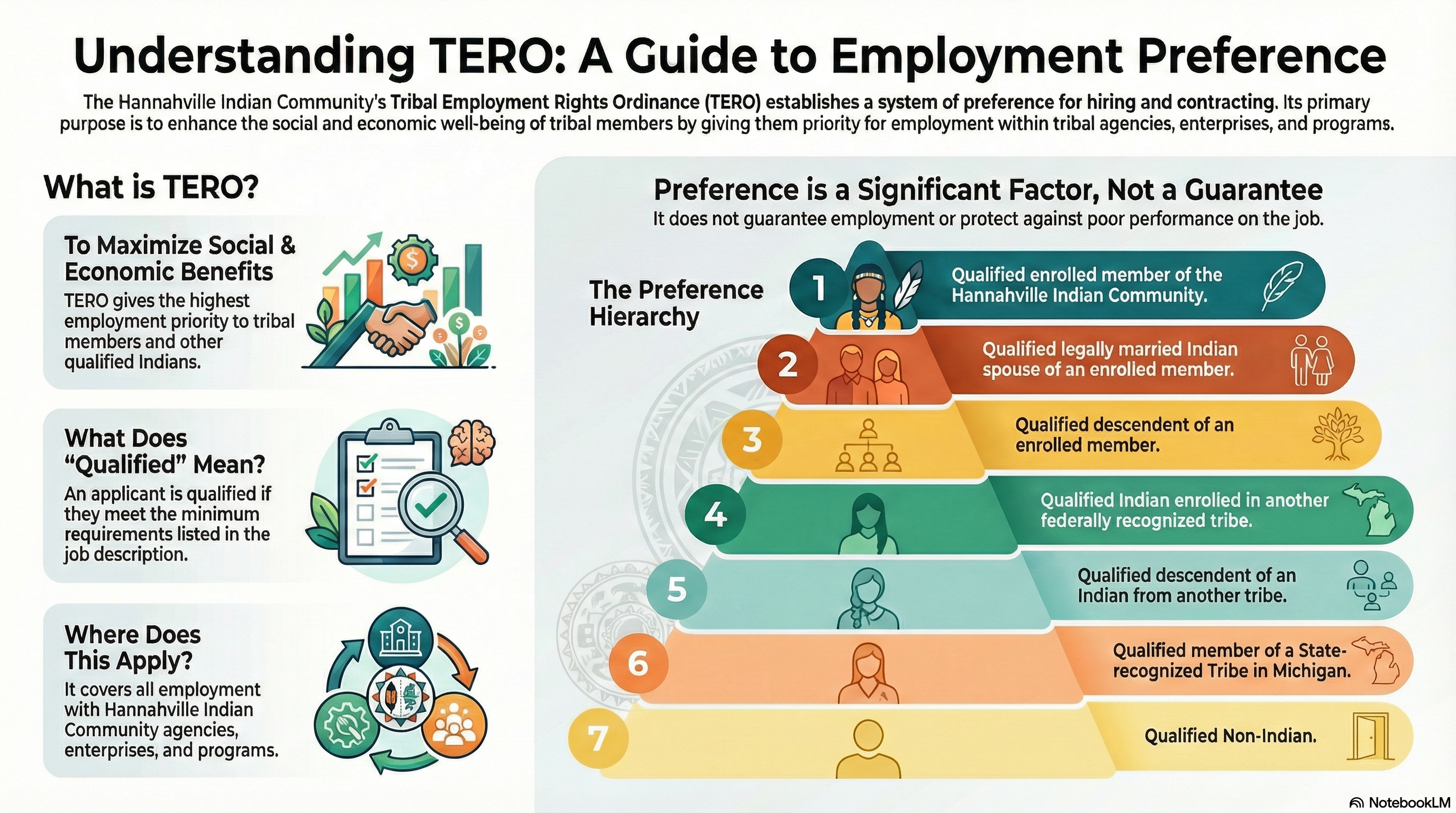
Currently, TERO provides for simple “preference,” but policy analysts argue this is insufficient. The recommendation is to weave a formal Succession Plan directly into tribal law. This would transform member advancement from a vague HR goal into a legal mandate. It would require the reservation of high-level positions for tribal members. Specific training pipelines would be implemented to fill them.
Furthermore, there is a massive untapped reservoir of political power in the “Tribal Youth” (ages 18-20). Recently granted voting rights, this demographic holds the potential to shift the trajectory of the CEO Board. However, they remain largely reengaged in the political process.
Digital Literacy and Civic Mastery
To bridge the gap between hourly work and executive management, the research suggests using Project-Based Learning (PBL). This should be delivered through digital platforms like Zoom and internal networks.
This shift toward digital communication is strategic. Traditional, static classroom environments can be intimidating for the 21-54 age group—the community’s largest voting bloc. Members can use accessible digital platforms. They can master the “complexities presented in the administration of Indian Gaming proceeds” on their own terms. Mastering the nuances of tribal law and corporate administration is the first step toward demanding accountability from the CEO Board.
Conclusion: From Shareholders to Successors
Tribal members are more than just employees of a casino. They are the primary beneficiaries and shareholders of a federal corporation. Indian Gaming has provided a baseline of economic stability. However, the promise of self-determination remains unfulfilled if outsiders man the community’s “cockpit”.
The Hannahville Indian Community can use legal levers like TERO. They can demand transparent, mandate-driven succession planning. This ensures that the wealth of their resources is managed by their own people. The proceeds of tribal gaming are meant to ensure the “highest quality of life.” We must ask: Is it enough to simply have a job? Or is it time to demand a seat at the management table?

Discover more from Hannahville Potawatomi
Subscribe to get the latest posts sent to your email.